
Oil shock and AI-spending jitters test markets as rate hikes return to the agenda
Our view this week: Brent crude jumped to about USD 117 a barrel, its highest level in months, after Houthi strikes on Saudi Arabia revived fears of a wider Middle East conflict. That collided with renewed doubts about AI capital spending after Meta lifted its capex floor, sending the Nasdaq down 2.6% on Thursday. The result was a rotation into defensives and government bonds: US 10-year yields fell 9bps to 5.00% despite the inflationary oil move. For Australian investors the focus now shifts home — Q3 CPI on 28 October will decide whether the RBA lifts the cash rate a fifth time this year on 3 November, with markets pricing roughly a 60–65% chance. We favour staying diversified, keeping duration in high-quality bonds now that yields are near 5%, and using volatility in quality growth names rather than chasing energy after a sharp run.
Key news: Brent hits a multi-month high on Houthi strikes on Saudi Arabia; Meta beats on earnings but lifts 2026 capex guidance to USD 135–145bn, reigniting AI-spend worries; SpaceX’s first big quarter shows revenue up 161% y/y; RBA Deputy Governor Hauser warns the inflation outlook has worsened, lifting November hike odds; NextDC falls 42% in a day after a grid-connection setback cuts guidance; EQT agrees to buy Cleanaway and Daiichi Life bids for Challenger; markets price a Fed hold on 28 October but a December hike.
Australia Market
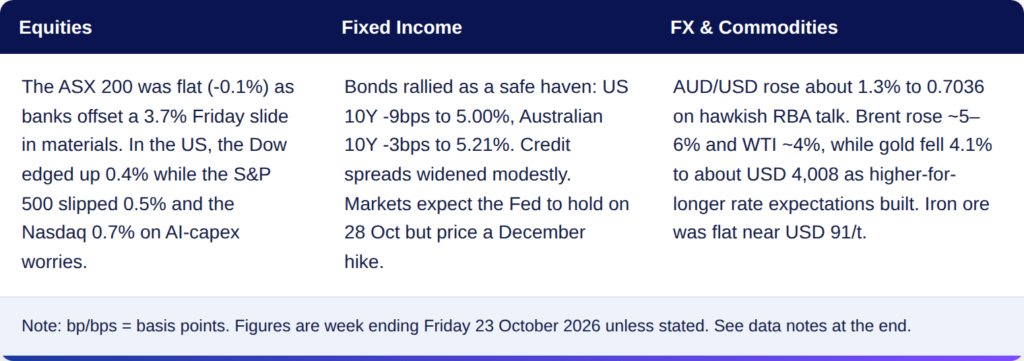
ASX: The S&P/ASX 200 closed Friday at 8,795.2, down about 0.1% for the week — its first weekly loss in four weeks. The index drifted lower from Wednesday’s 8,831 as hawkish RBA commentary lifted the odds of another rate rise. On Friday, banks rallied (Financials +1.7%) while Materials fell 3.7% as gold slid and BHP’s copper output disappointed.
Sectors: Defensive and rate-sensitive income sectors held up best, with Financials, Consumer Discretionary and Utilities leading on Friday. Materials was the clear laggard: a third lithium bear market in a decade (Pilbara Minerals, Liontown and Mineral Resources down 19–34% over a month), Fortescue’s guidance warning and gold’s 4% weekly fall all weighed.
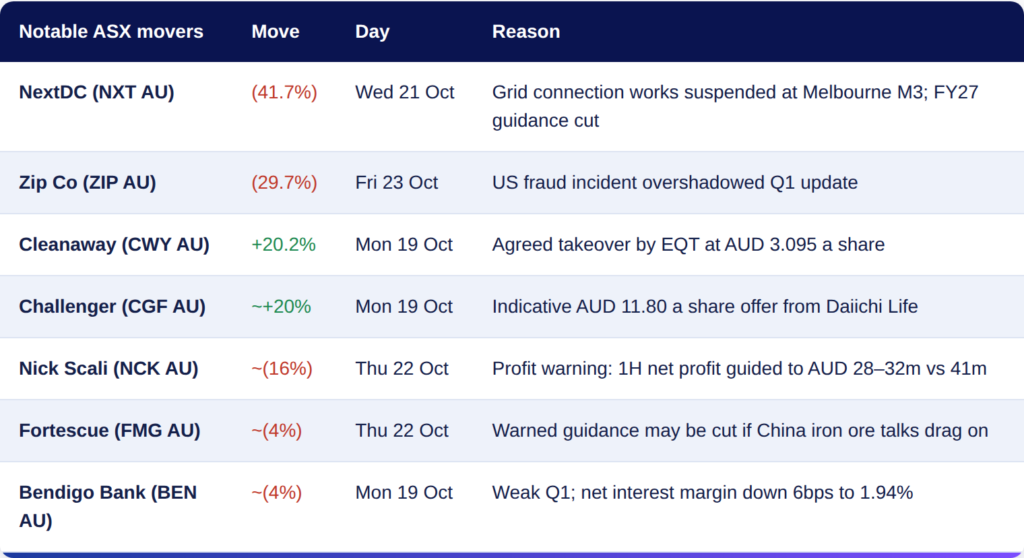
Corporate activity: Takeover interest returned. EQT agreed to buy Cleanaway at AUD 3.095 a share (about AUD 9.3bn including debt), and Japan’s Daiichi Life made an indicative AUD 11.80 a share offer for Challenger, in which it already owns 20.4%.
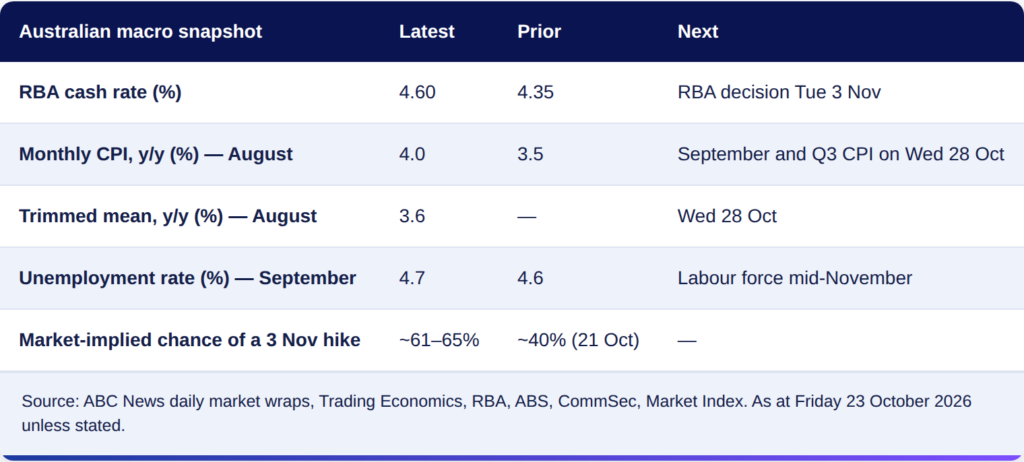
RBA & macro: The cash rate is 4.60% after four rises this year. Deputy Governor Hauser said on 21 October that the inflation outlook was worse than in August, with oil about a third above RBA assumptions. Markets now price roughly a 60–65% chance of a fifth hike on 3 November, and fully price one by February 2027. Flash October PMIs were weak, with services falling to 47.8 from 51.9, and Domain reported a record 4.7% fall in capital-city house prices in the September quarter.

Stock Highlight
NextDC (NXT AU; about AUD 5.35 after the fall) — grid delay turns an AI winner into a reminder about execution risk. NextDC shares fell about 42% on 21 October after Jemena suspended grid connection works at its M3 Melbourne data centre, with works not expected to restart before February 2027. The company cut FY27 underlying EBITDA guidance to AUD 245–265m (from 385–410m) and revenue to AUD 475–500m (from 615–640m), and trimmed capex to AUD 4.5–5.0bn. Liquidity of AUD 8.68bn at 30 September looks adequate, but about AUD 6.7bn of undrawn senior debt is now at risk. Even after the fall, brokers note the stock trades at a premium to global data-centre peers. Our take: demand for AI data capacity remains strong, but power access is now the bottleneck — investors should favour operators with secured grid capacity and diversified sites.
US Market
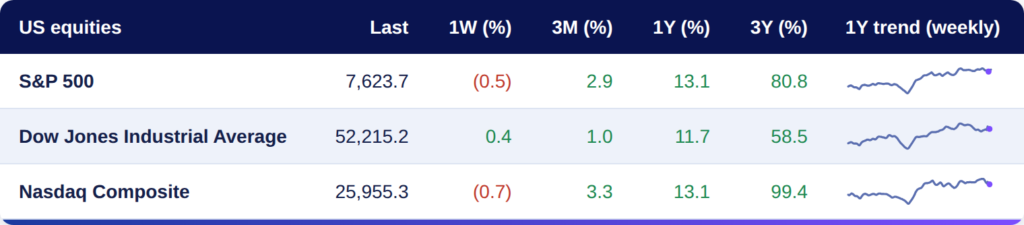
Indices: A choppy week ended mixed. The Dow rose 0.4% to 52,215 despite a 650-point fall on Friday, while the S&P 500 lost 0.5% to 7,624 and the Nasdaq fell 0.7% to 25,955. The S&P 500 is still up about 13% over the past year.
Drivers: Stocks rose through Wednesday after strong results from SpaceX and Super Micro, but Meta’s higher capex guidance sparked Thursday’s AI sell-off (S&P ‑1.2%, Nasdaq ‑2.6%). Friday’s oil spike on Middle East escalation added pressure.
Breadth & earnings: Under the surface, the average S&P 500 stock rose 1.1% while the Magnificent 7 fell 2.0% — a sign that money is rotating rather than leaving the market. Of the 24% of S&P companies that have reported Q3, 83% beat estimates, and blended earnings growth is running near 30%.
Fed: The FOMC decides on 28 October. Markets expect a hold at 3.75–4.00% but price a roughly 76–80% chance of a December hike, with September CPI at 3.7% y/y and oil adding to inflation risk.
Stock Highlights
SpaceX (SPCX US) — AI infrastructure is now the biggest business. SpaceX’s Q3 revenue rose 161% y/y to USD 14.6bn, well ahead of the roughly 12.5bn expected, and it earned USD 4.4bn of net profit. The AI segment, which includes xAI, grew about 830% to USD 7.6bn; Starlink revenue rose about 70% to USD 5.2bn with 13.6m subscribers; launch added USD 1.8bn. Capex was USD 19.6bn. Elon Musk said the boards of SpaceX and Tesla have formed special committees to study a merger. The shares rose 7.8% on 21 October. Our take: growth is exceptional, but a large share lock-up expiry and merger uncertainty could make the stock volatile.
Meta Platforms (META US) — strong quarter, but the market balked at the spending bill. Meta’s Q3 adjusted EPS of USD 7.40 beat consensus by about 13.5%, and Q4 revenue guidance of USD 73–76bn was in line. However, it raised the floor of its 2026 capex range to USD 135–145bn and took a USD 9.89bn legal charge, and the stock fell about 7% the next day. Our take: the sell-off shows investors now want proof that AI spending will earn a return. We prefer a diversified exposure to AI over concentrated bets on the biggest spenders.
Fixed Income
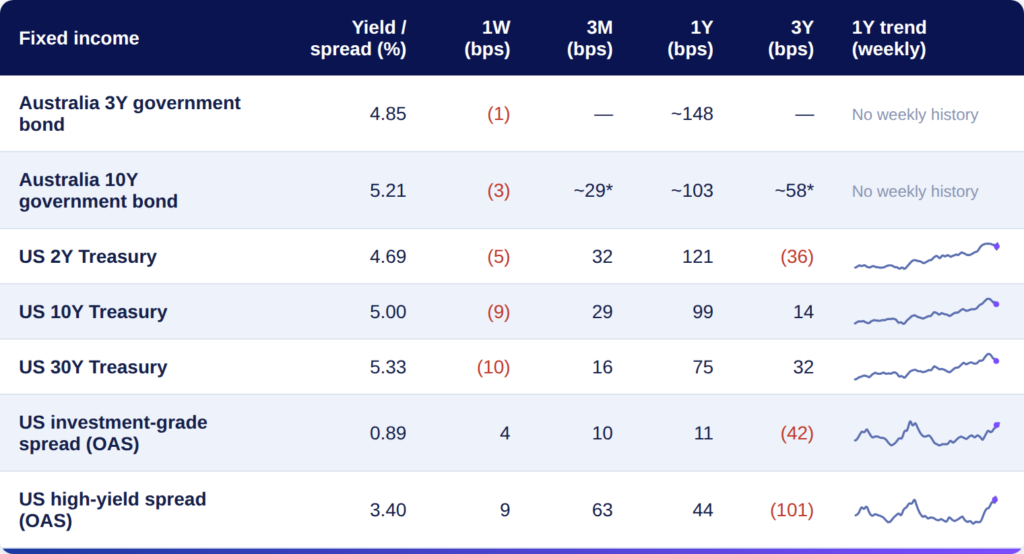
Australia: Australian government bond yields fell only modestly — 3Y to 4.85% and 10Y to 5.21% — lagging the US rally because hawkish RBA comments lifted near-term hike expectations. Australian 10Y yields are up about 1 percentage point over the past year, and the AU–US 10Y spread is about +21bps. This week’s Q3 CPI is the key risk for the front end.
US Treasuries: Yields rose early in the week (10Y peaked at 5.15% on Wednesday), then fell 17bps on Thursday — the biggest one-day drop in more than a year — as investors sought safety during the AI sell-off and Middle East escalation. Over the week the 2Y fell 5bps to 4.69%, the 10Y 9bps to 5.00% and the 30Y 10bps to 5.33%, flattening the curve.
Credit: US investment-grade spreads widened 4bps to 89bps and high-yield 9bps to 340bps, with most of the move on Thursday’s risk-off day. Spreads remain tight by historical standards, so we prefer quality over yield-chasing in high yield.
Our take: With US and Australian 10-year yields both above 5%, high-quality bonds again offer meaningful income and a buffer if growth slows. We would add duration gradually rather than all at once, given hike risk from the RBA and Fed.
FX & Commodities
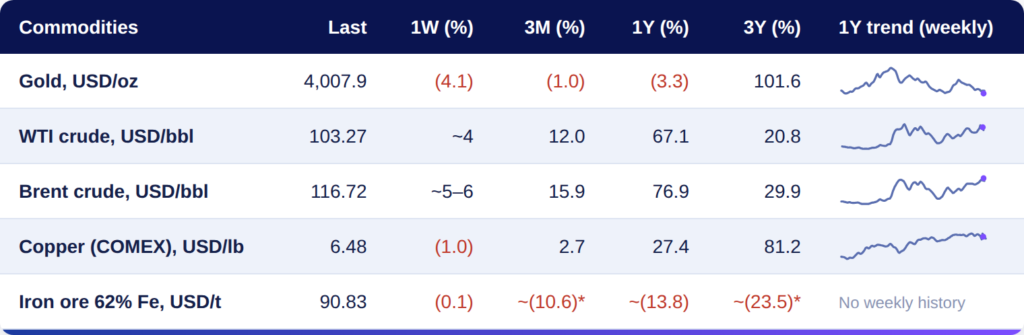
Energy: Oil surged on Friday after Houthi attacks on Saudi Arabia and expectations of renewed US strikes on Iran; Saudi Aramco reportedly told staff to evacuate its Dhahran headquarters. Front-month Brent closed near USD 117 a barrel, up roughly 5–6% on the week, and WTI rose about 4% to USD 103. US crude inventories fell 3.1m barrels, more than expected, and the US Energy Department announced a 315,000-barrel loan from its Northeast heating-oil reserve as heating-oil futures neared record levels.
Gold & metals: Gold fell 4.1% to about USD 4,008 an ounce, its lowest since mid-July, as hotter US inflation and the oil spike pushed out rate-cut hopes. Copper slipped 1% to a five-week low during the AI sell-off. Iron ore was steady at about USD 91 a tonne.
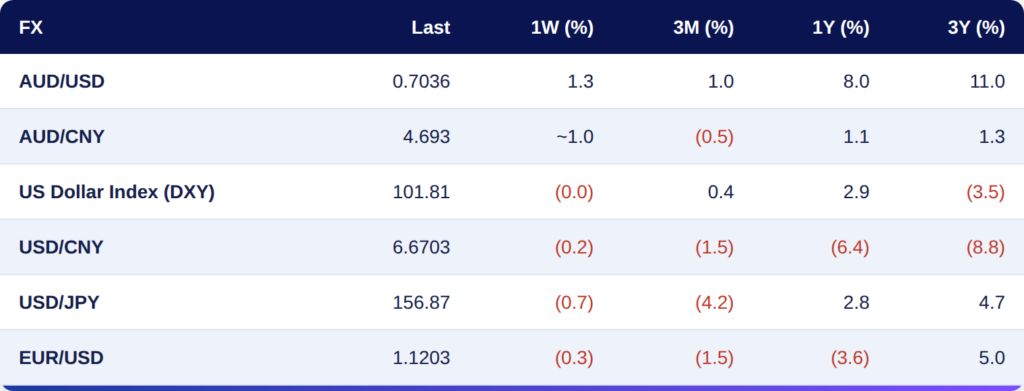
FX: The US Dollar Index was flat at 101.8. AUD/USD rose about 1.3% to 0.7036, near a five-week high, as hawkish RBA comments widened the expected rate gap with the Fed. That also lifted the AUD against the CNY by about 1%. The yen firmed 0.7% to 156.9 per US dollar on safe-haven demand.
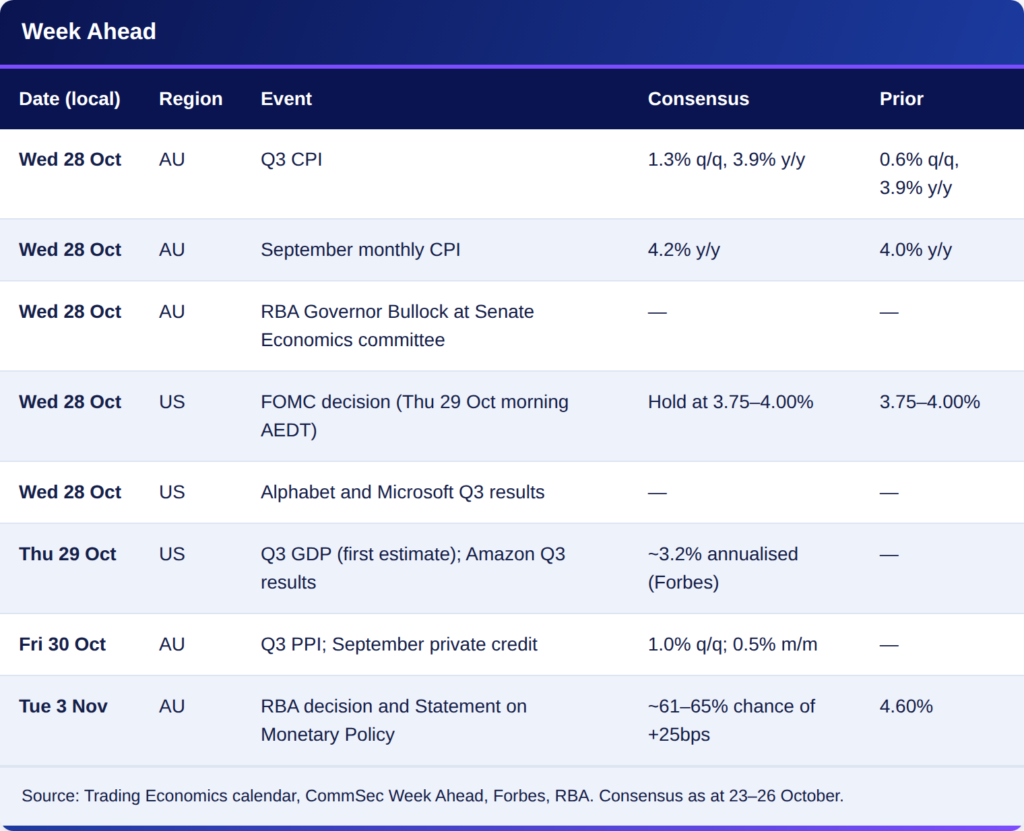
Also reporting this week: Boeing, Coca-Cola, UPS, Eli Lilly, Starbucks, Chevron and ExxonMobil, among 179 S&P 500 companies.
Questions about how this week’s moves could affect your portfolio? Speak with your BOA Private Wealth adviser.
This article is intended as general information only and does not constitute legal, financial or tax advice. Specific eligibility and the amount of any refundable tax offset should be determined based on the company’s individual circumstances and the applicable tax legislation.