
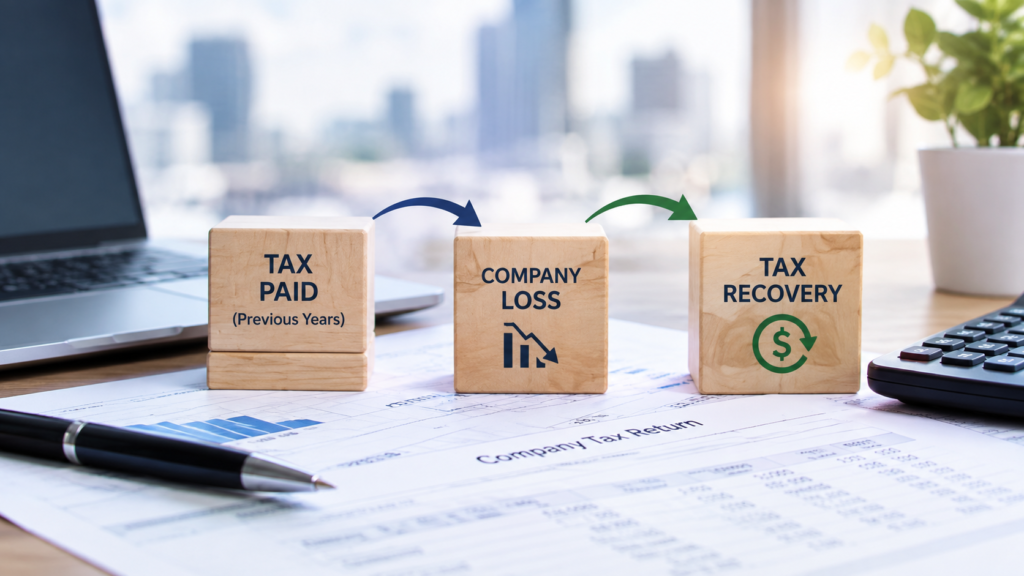
When a company experiences a tax loss after previously generating taxable profits and paying company tax, it may be possible to obtain a refundable tax offset by carrying the loss back against eligible prior-year taxable income.
This can provide an important cash-flow benefit for eligible businesses experiencing a temporary downturn.
However, the rules are subject to specific eligibility requirements and limitations. A company should assess its tax loss, prior-year tax liabilities, and franking account position before determining whether the loss carry-back measure is available and beneficial.
For more details, visit the ATO’s Tax Reform – Tax Loss Carry Back https://www.ato.gov.au
What is Loss Carry-Back?
Under the loss carry-back rules, an eligible company may be able to apply a current-year tax loss against taxable income from eligible prior income years. This is different from the traditional treatment of tax losses.
Under the traditional approach, a company generally carries its tax losses forward and uses them to reduce taxable income in future years when the company returns to profit.
Loss carry-back provides an alternative: rather than waiting for future profits, an eligible company may be able to use the current year’s loss to obtain a refundable tax offset relating to company tax paid in earlier years.
Example:
Assume a company has the following results:
Income year | Taxable Profit/(loss) | Company Tax |
2024–25 | $80,000 profit | $20,000 |
2025–26 | $40,000 profit | $10,000 |
2026–27 | $60,000 tax loss | — |
If the company satisfies the relevant requirements, the $60,000 tax loss may potentially be carried back against eligible prior-year taxable income.
At a 25% company tax rate:
$60,000 × 25% = $15,000
Accordingly, the company may potentially receive a refundable tax offset of up to $15,000, subject to the applicable limits and the company’s circumstances.
Importantly, this does not mean that the company is receiving a separate $15,000 government payment simply because it incurred a loss. Rather, the mechanism allows eligible companies to recover some company tax previously paid, through the refundable tax offset mechanism.
2. Loss Carry-back does not mean changing previous tax returns
A common misconception is that applying loss carry back requires the company to amend its previous income tax returns and retrospectively reduce the taxable income reported in those years.
This is not the way the mechanism operates.
The company generally makes the relevant choice in its current-year Company Tax Return, rather than reopening the previous years’ tax returns simply to insert the current-year loss.
The previous years’ taxable income and tax liabilities remain relevant because they determine the amount against which the current-year loss may be carried back.
3. Not every business loss qualifies
One of the most important considerations is that not every type of taxpayer can use the company loss carry-back rules.
The measure is principally relevant to eligible corporate tax entities that satisfy the applicable requirements.
For example, a loss incurred by a sole trader is not a corporate tax loss that can simply be used to obtain a refund of the individual’s income tax paid in previous years.
Similarly, a loss incurred by one entity cannot simply be transferred to another related entity because the entities are owned by the same family or group.
Example — Family Trust and Company
Assume:
- A Family Trust previously distributed income to a company.
- The company paid company tax on its taxable income.
- In a later year, the Family Trust itself incurs a tax loss.
The Trust’s loss does not simply become the company’s loss and cannot automatically be used by the company to recover company tax that the company paid in earlier years.
The relevant question is which taxpayer actually incurred the tax loss and which taxpayer previously paid the relevant tax.
This is why the entity’s legal and tax structure needs to be considered carefully.
4. Accounting loss is not necessarily the same as a tax loss
Another important distinction is between an accounting loss and a tax loss.
A company may report a loss in its financial statements, but this does not necessarily mean that it has a tax loss of the same amount.
Taxable income is calculated under the tax rules and may require adjustments to accounting profit or loss.
For example, adjustments may arise from:
- depreciation and tax depreciation differences;
- expenses that are not deductible for tax purposes;
- capital expenditure;
- entertainment expenses;
- fines and penalties;
- private or non-deductible expenditure;
- related-party transactions;
- inventory adjustments; and
- other tax adjustments.
Therefore, the loss carry-back calculation should be based on the company’s tax loss, rather than simply the accounting loss shown in the financial statements.
5. The Franking Account balance is important
The amount of refundable tax offset available under the loss carry-back rules is not necessarily equal to the company’s entire historical tax payments.
The Franking Account balance is one of the relevant limitations.
For example, assume a company calculates that its current-year tax loss could potentially generate a $15,000 refundable tax offset.
If the company’s relevant available franking account balance is only $8,000, the amount that can ultimately be claimed may be restricted to $8,000, subject to the applicable rules.
This is particularly important for companies that have previously paid fully franked dividends to shareholders.
When a company pays a fully franked dividend, franking credits are attached to the dividend and the company’s franking account is affected.
Therefore, companies considering loss carry back should consider not only:
“How much company tax did we pay previously?”
but also:
“What is our available franking account balance?”
6. Consider the impact before declaring dividends
For companies that are considering paying dividends, the interaction between loss carry back and franking credits should be considered as part of the overall tax planning process.
A company may have previously paid company tax and generated franking credits. However, those franking credits may have already been used when franked dividends were paid to shareholders.
As a result, the company’s potential loss carry-back benefit may be affected.This means dividend decisions should not necessarily be considered in isolation from the company’s tax position.
7. When should a company consider assessing loss carry back?
Businesses that have previously generated profits and paid company tax may wish to assess the rules where they expect to experience a significant tax loss.
Examples may include:
- a significant decline in business revenue;
- substantial one-off employee or operating costs;
- significant expenditure associated with expansion;
- qualifying asset purchases and depreciation deductions;
- opening a new business location;
- temporary business disruption; or
- significant inventory write-downs or bad debts.
The earlier the potential tax loss is identified, the earlier the company can assess the potential cash-flow implications.
8. What should businesses review?
Before determining whether loss carry back is available and beneficial, we recommend reviewing:
- Current-year tax position
Determine whether the company has actually generated a tax loss after all relevant tax adjustments. - Previous-year taxable income and company tax paid
Establish the relevant prior-year amounts that may potentially be considered. - Franking Account balance
Consider whether the available franking balance may limit the refundable tax offset. - Dividend and franking history
Review whether franking credits have already been distributed to shareholders. - Entity structure
Confirm that the entity claiming the loss is an eligible taxpayer and that the loss belongs to that entity. - Future tax position
Consider whether carrying the loss forward may be more beneficial than carrying it back, depending on the company’s circumstances.
BOA & Co. Key Takeaway
For eligible companies, a current-year tax loss may potentially provide an opportunity to recover some company tax paid in earlier years through the loss carry-back refundable tax offset mechanism.
However, the calculation is not simply:
Current-year loss × company tax rate = refund
The potential benefit can be affected by the company’s prior-year tax liabilities, franking account balance, tax loss calculation and other eligibility requirements.
Businesses that expect to move from a period of profitability into a significant tax loss should consider assessing their position as part of their tax planning and cash-flow management.
BOA & Co. can assist with reviewing your company's tax position and assessing whether the loss carry-back rules may be relevant to your circumstances.
This article is intended as general information only and does not constitute legal, financial or tax advice. Specific eligibility and the amount of any refundable tax offset should be determined based on the company’s individual circumstances and the applicable tax legislation.