
Hot US CPI, Nvidia Turmoil and a 10-Month Low for the AUD
This week at a glance
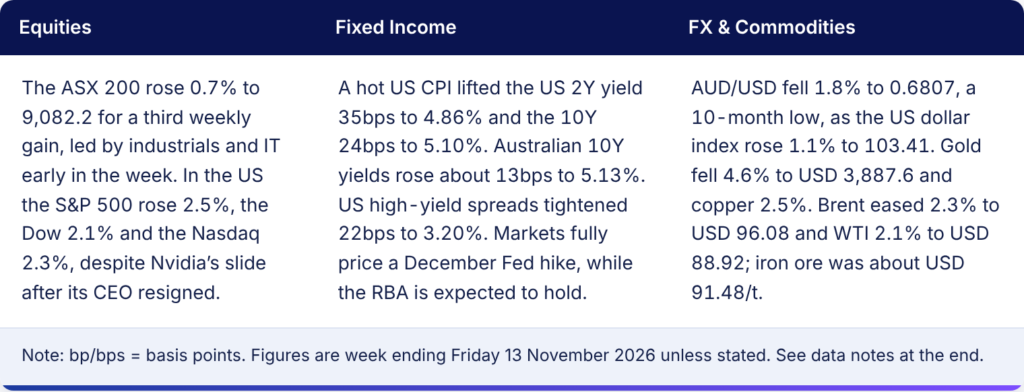
A hot US inflation print and a leadership crisis at Nvidia dominated the week, lifting US bond yields to new cycle highs and pushing the Australian dollar to a 10-month low. US October CPI rose 0.4% m/m against 0.3% expected, Fed officials openly floated a 50bps move, and markets now fully price a December Fed hike. The US 2Y Treasury yield jumped 35bps to 4.86% and the 10Y 24bps to 5.10%. Nvidia fell on four of five days and CEO Jensen Huang resigned on Thursday, yet the S&P 500 still rose 2.5% to 7,561.7 after a 2.4% rally on Monday. The ASX 200 gained 0.7% to 9,082.2, its third weekly rise, even as Westpac consumer sentiment fell to a four-year low of 78.2 and Q3 new home lending dropped a record 15.5%. AUD/USD fell 1.8% to 0.6807 and gold slid 4.6% to USD 3,887.6. At BOA we see a widening policy gap, with the RBA likely on hold while the Fed keeps tightening. We continue to favour diversified portfolios, with quality bonds yielding around 5% as ballast, and patience with AI-linked growth stocks while governance and policy risks settle.
Australia Market
ASX: The S&P/ASX 200 closed Friday at 9,082.2, up 0.7% for the week and its third straight weekly gain. It edged up 0.1% on Monday, rallied 1.1% on Tuesday as bond yields and oil eased, and added 0.3% on Wednesday to close about 1.5% below its August record of 9,296.7. It slipped 0.1% on Thursday and fell 0.7% on Friday as US yields climbed, with 147 stocks falling and 44 rising.
Sectors: Weekly sector figures were not available. Materials swung most, up 3.2% on Monday on gold, base metals and uranium, then down 2.1% on Thursday and 1.7% on Friday as gold fell below USD 4,000 (Northern Star ‑2.8%, Evolution ‑2.9% on Friday). Industrials (+2.3%) and A-REITs (+2.2%) led Tuesday’s broad rally and IT led on Wednesday. Banks were mixed around CBA’s update, and utilities were the best sector on Friday (+1.5%).
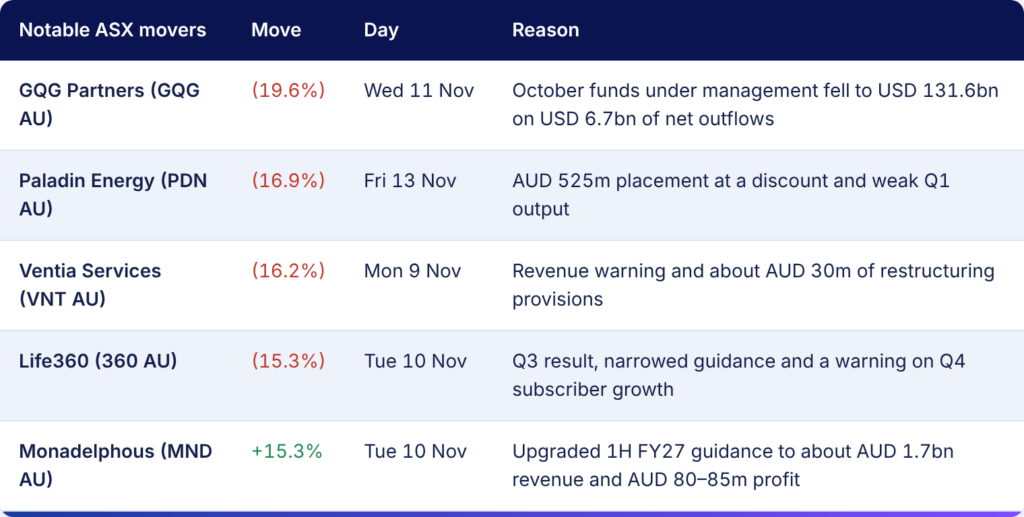
Corporate activity: CBA’s Q1 FY27 cash profit rose about 8% to about AUD 2.8bn, but loan impairment expense rose to AUD 300m and home loan arrears to 0.80%; ASIC is also suing CBA over alleged overcharging of business customers. Xero raised FY27 revenue guidance to NZD 3.77–3.83bn and announced an AUD 1bn buyback. Paladin Energy raised AUD 525m at AUD 7.80 a share, and GQG Partners hit a record low after October funds under management fell to USD 131.6bn. NAB will pay AUD 127m to underpaid staff, and Anthropic lodged an Australian prospectus ahead of a Nasdaq listing expected on 20 November.
RBA & macro: The cash rate is 4.85% after the 3 November hike. Assistant Governor Sarah Hunter said on Monday that AI investment adds some near-term upward pressure on inflation and may raise the neutral rate. Data were weak: Westpac-MI consumer sentiment fell 2.7% to 78.2, a four-year low, with mortgage-holder sentiment at a record low. NAB business conditions fell to ‑2, the lowest since August 2020, and confidence to ‑15. Q3 new home loan values dropped a record 15.5% q/q, led by a 32.3% fall in investor lending, while consumer inflation expectations held at 5.3%. A market-implied probability for the next meeting on 8 December was not found; Trading Economics says markets see about an 82% chance that rates have peaked, and Westpac expects a hold. November minutes are due on 17 November and October jobs data on 19 November.

US Market
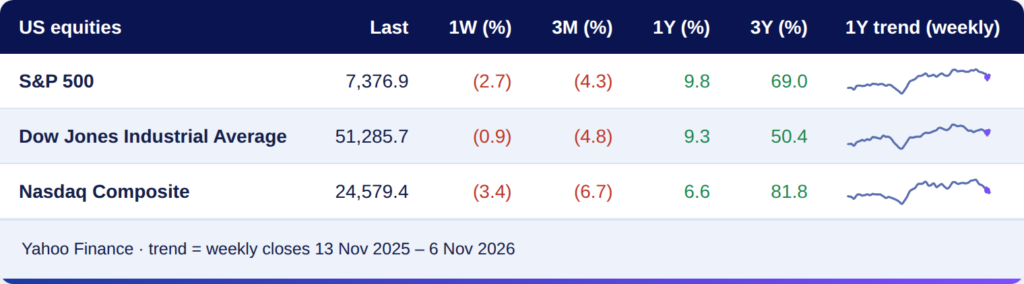
Indices: Stocks recovered most of last week’s losses despite turmoil at Nvidia. The S&P 500 rose 2.5% to 7,561.7, the Dow 2.1% to 52,347.6 and the Nasdaq 2.3% to 25,136.3. Monday did most of the work, with the S&P 500 up 2.4% and the Nasdaq 2.7% on chip dip-buying and lower oil. The S&P 500 slipped 0.4% after Tuesday’s CPI data, rose 1.3% on Wednesday, then eased on Thursday and Friday as AI chip stocks sold off again.
Drivers: October CPI rose 0.4% m/m against 0.3% expected, and core CPI 0.3% against 0.2%; annual rates were not published because October 2025 prices were not collected during the government shutdown. PPI rose 0.3% m/m, below the 0.4% expected, but 6.5% y/y, the highest since November 2022. Initial jobless claims rose to 200,000 from 191,000. The 10Y Treasury yield moved back above 5% after the Veterans Day holiday.
Breadth & earnings: Nvidia fell about 4% on Monday, 5.5% on Tuesday, 4.3% on Thursday and 2.0% on Friday after reports of a board investigation; CEO Jensen Huang resigned on Thursday, with results due on 17 November. AMD rose 5.9% on Thursday as investors rotated into rivals, then fell 8.8% on Friday in an AI-chip sell-off. CoreWeave jumped about 21% on Wednesday on a Q3 beat and raised guidance, Nebius fell 16.8% on Thursday after cutting its 2026 outlook, and Cisco fell 6.2% on Friday despite raising guidance. Per FactSet, 91% of S&P 500 companies have reported Q3 and 84% have beaten earnings estimates.
Fed: The funds rate is 3.75–4.00%. Governor Waller said a 50bps hike “should be considered” in December, and Dallas Fed President Logan said at least two more 25bps increases are needed. After the CPI data, CME FedWatch put the chance of a 25bps hike on 9 December at 88.8% and of a 50bps hike at 11.2%, leaving no chance of a hold; a Friday reading was not found.
Fixed Income
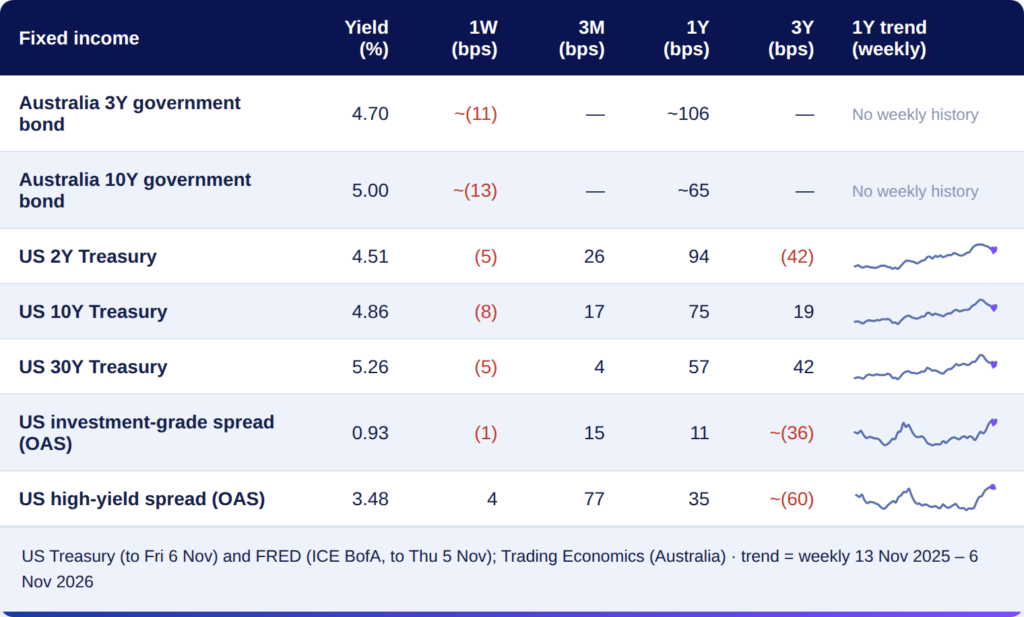
Australia: Australian yields rose with US Treasuries after the hot US CPI, but by less. Trading Economics shows the 3Y at 4.82% and the 10Y at 5.13% on Friday, each up about 12–13bps on the week, with the 10Y at its highest in almost two weeks. Because markets see the RBA as done while the Fed keeps hiking, the gap between Australian and US 2Y yields narrowed to about 3bps from 36bps a week earlier, and the Australian 10Y was reported to have dipped below the US 10Y for the first time in over a year.
US Treasuries: On Treasury’s official data, which run to Thursday 12 November, the 2Y rose 35bps to 4.86%, the 10Y 24bps to 5.10% and the 30Y 17bps to 5.43%. The 2Y jumped about 20bps on CPI day, its biggest one-day rise since 2024, and Thursday’s USD 25bn 30Y auction drew softer demand at 5.441%. Market quotes put the 10Y near 5.15% at Friday’s close. The 2Y–10Y curve flattened to about 24bps from 35bps.
Credit: US investment-grade spreads tightened 4bps to 0.89% and high-yield spreads 22bps to 3.20% to 12 November, reversing most of last week’s widening as equities rebounded. Spreads still leave little room for a slower economy under further Fed hikes, so we continue to prefer quality.
Our take: With US and Australian 10-year yields above 5%, high-quality bonds offer attractive income. The Fed is still tightening, so US short-term yields can rise further; we would keep adding duration gradually, with a tilt to Australian bonds where the RBA appears to have peaked.
FX & Commodities
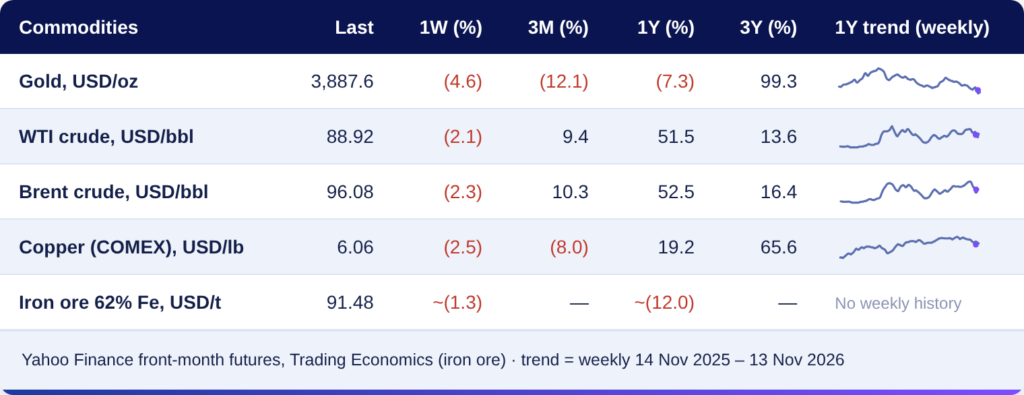
Energy: Oil fell for a second week, though far less than the week before. Front-month Brent eased 2.3% to USD 96.08 and WTI 2.1% to USD 88.92. Brent fell nearly 5% on Monday as Qatar took an Iranian plan to reopen the Strait of Hormuz to the White House, and settled at USD 91.49 on Tuesday, its lowest since August. Prices rebounded about 3% on Thursday on unconfirmed reports of attacks on Saudi pipeline facilities and tankers near Hormuz. The IEA says the market moved into a surplus of nearly 2 mb/d in October, and US crude stocks rose 4.7 mb; OPEC+ meets on 29 November.
Gold & metals: Gold fell 4.6% to USD 3,887.6 an ounce, dropping below USD 4,000 and to its lowest in over a year as US yields rose and markets priced a December Fed hike. COMEX copper fell 2.5% to USD 6.06 a pound and LME copper had a fifth straight weekly fall, hit by the AI-equity sell-off, although Shanghai exchange stocks fell to their lowest since December 2023. Iron ore eased about 1% to USD 91.48 a tonne as Chinese port stocks rose to 152 mt.
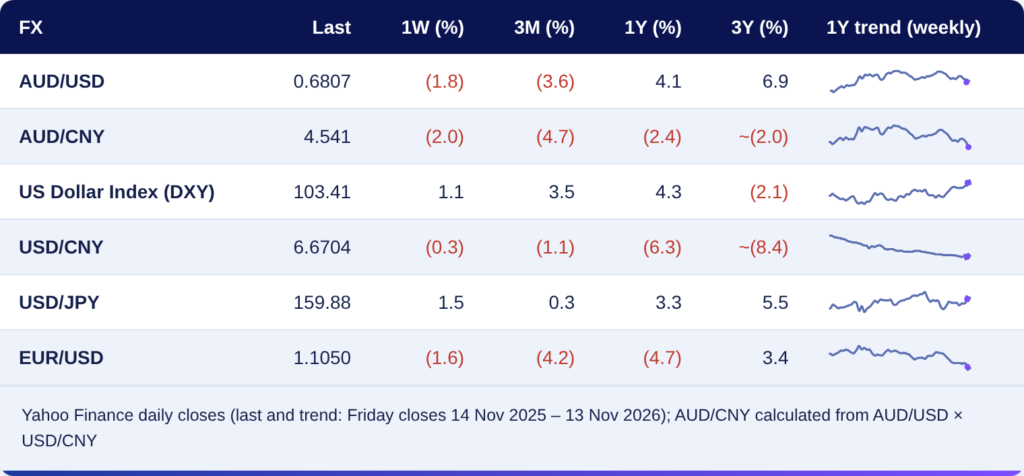
FX: AUD/USD fell 1.8% to 0.6807 on Yahoo’s daily close and traded near 0.677 late on Friday, its lowest since late January, as US rate-hike bets lifted the US dollar while the RBA is seen on hold. The US Dollar Index rose 1.1% to 103.41, near a 19-month high. USD/CNY eased 0.3% to 6.6704 and the PBoC set Friday’s fixing at 6.7152; its higher FX reserve requirement for banks takes effect on 15 November, and new yuan loans contracted by 100bn yuan in October. AUD/CNY fell 2.0% to 4.541. USD/JPY rose 1.5% to 159.88, close to 160 as warnings of Japanese intervention resurfaced, and EUR/USD fell 1.6% to 1.1050.
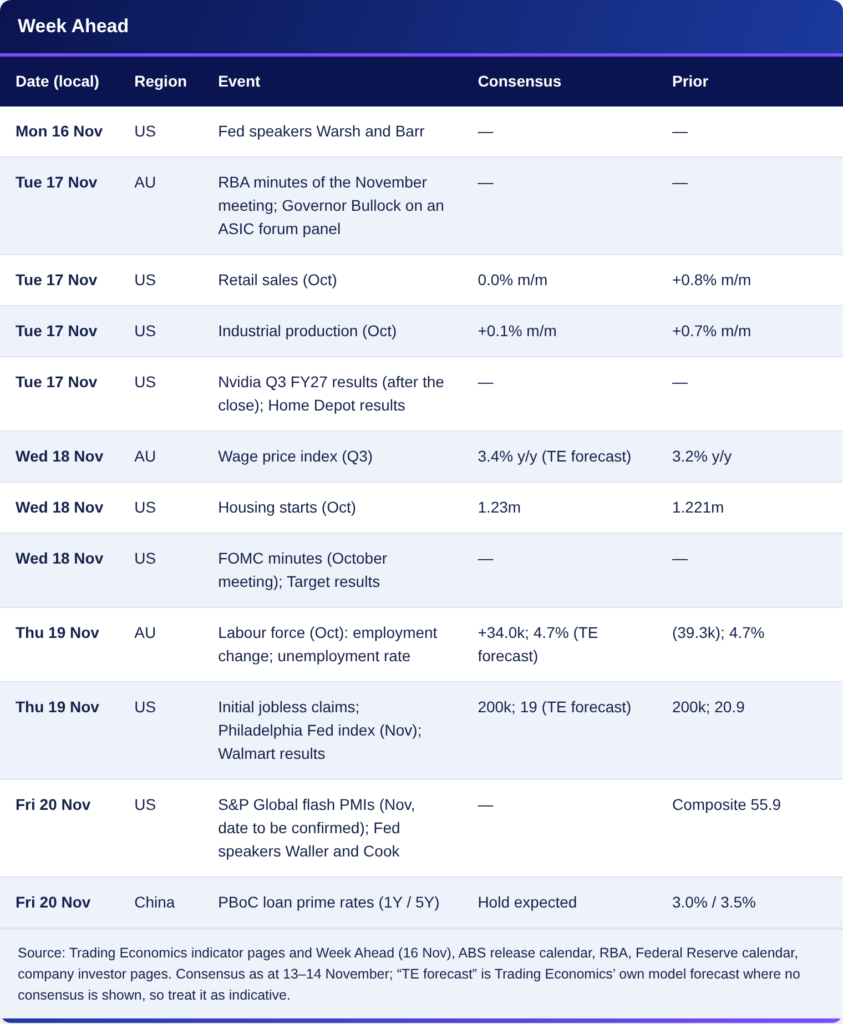
No RBA, Fed or BoJ policy decisions fall in the week; the PBoC’s loan prime rate setting on 20 November is expected to be unchanged. The next RBA decision is 8 December, the FOMC decides on 9 December and the BoJ meets on 17–18 December. Nvidia’s first results since its CEO’s exit and the FOMC minutes are the key US events, while Australia’s wage and jobs data will test the view that the RBA has finished hiking.
Questions about how this week’s moves could affect your portfolio? Speak with your BOA Private Wealth adviser.
This article is intended as general information only and does not constitute legal, financial or tax advice. Specific eligibility and the amount of any refundable tax offset should be determined based on the company’s individual circumstances and the applicable tax legislation.