

Tech shares slide, RBA decision ahead
This week at a glance
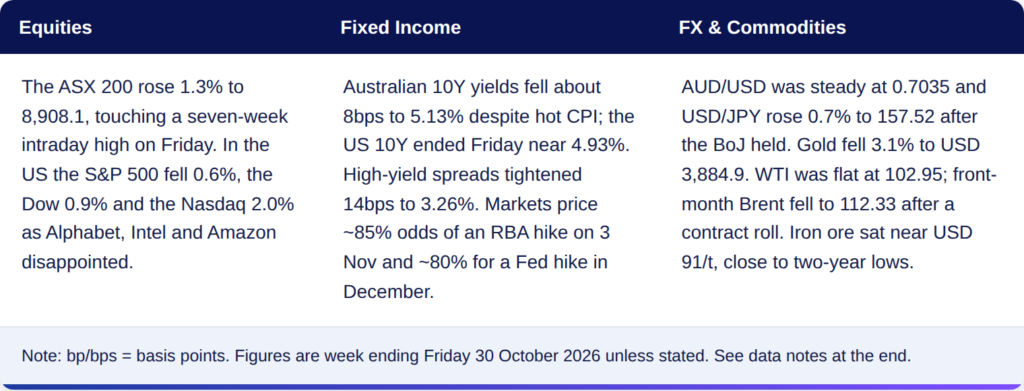
Hot inflation and a fresh AI-led tech sell-off set the tone as central banks leaned hawkish. Australia’s Q3 CPI rose 1.3% q/q (3.9% y/y), the trimmed mean reached 3.7% y/y, a touch above forecasts, and September’s monthly CPI hit 4.3%; markets now price about an 85% chance the RBA lifts the cash rate to 4.85% on 3 November, and all four major banks expect a hike. Even so, the ASX 200 rose 1.3% to 8,908.1, led by banks and property. In the US, the Fed held at 3.75–4.00% in a 10–2 vote, with two dissents favouring a hike, and Q3 GDP grew 3.4% annualised. Big tech results disappointed: Alphabet fell more than 12% on Thursday and Intel 29% on Friday, pulling the Nasdaq down 2.0% for the week and 5.2% for October. Gold fell 3.1% to about USD 3,885 an ounce, while oil held above USD 100 a barrel. At BOA we continue to favour diversified portfolios, with high-quality bonds yielding close to 5% as a buffer, and see AI-driven volatility as a chance to add selectively to quality growth rather than a reason to step away from equities.
Australia Market
ASX: The S&P/ASX 200 closed Friday at 8,908.1, up 1.3% for the week and about 1.4% for October. Thursday’s 0.5% gain took the index to a 20-day high, and on Friday it touched about 8,986 — a seven-week high — before fading as US futures fell on Alphabet’s slump. Wednesday was flat: early gains of up to 0.9% were given back after the hotter-than-expected trimmed-mean CPI.
Sectors: Weekly sector figures were not available. Rate-sensitive and financial stocks did best mid-week (on Thursday real estate +1.3% and financials +1.2%), while consumer stocks lagged (staples ‑2.1%, discretionary ‑1.9%). Coles fell 7.6% on Friday after a weak Q1 update, while Woolworths reported Q1 sales up 4.7% to AUD 19.4bn. Rare-earths stocks rallied on Wednesday on a federal refining policy revamp.
Corporate activity: Challenger rejected Dai-ichi Life’s AUD 11.80 a share (about AUD 8.4bn) proposal and is seeking a higher offer. BlueScope lifted 1H pre-tax profit guidance to approaching AUD 1.1bn, from AUD 860–960m. Star Entertainment was fined AUD 260m (AUSTRAC had sought AUD 400m), in line with its provision. Woodside agreed to sell its Sunrise interest for up to USD 200m, and Suncorp cut its premium growth guidance to about 3%.
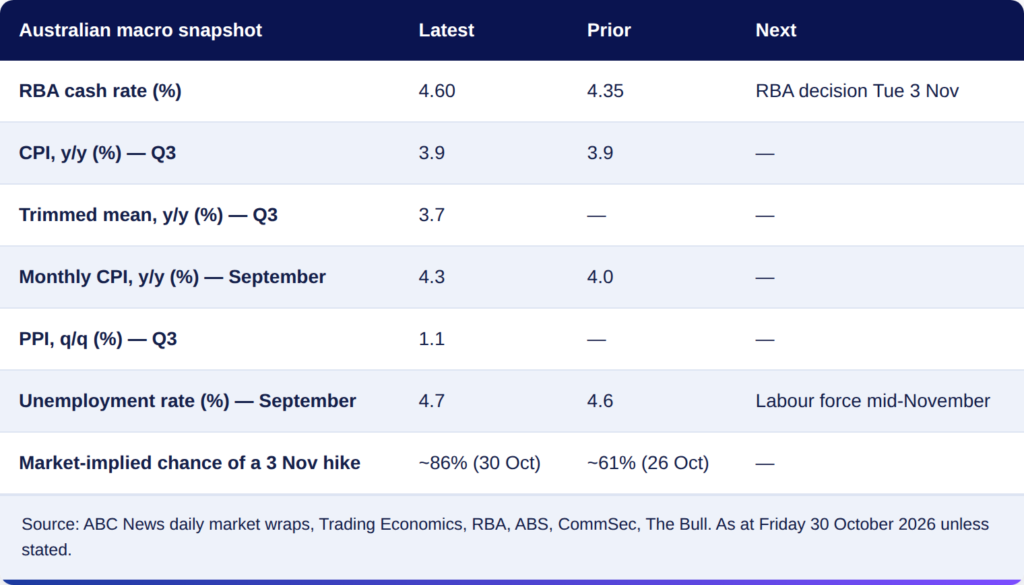
RBA & macro: The cash rate is 4.60%. Q3 CPI rose 1.3% q/q and 3.9% y/y, in line, but the trimmed mean rose 3.7% y/y versus 3.6% expected, and September’s monthly CPI jumped to 4.3% (0.8% m/m). Q3 PPI rose 1.1% q/q and private credit 0.6% in September. Governor Bullock told Senate Estimates that supply shocks “worsen the trade-off” and data centres are adding to inflation. Market-implied odds of a hike on Tuesday 3 November rose from about 61% on Monday to about 86% on Friday, and all four major banks expect a 25bps rise to 4.85%, with the Statement on Monetary Policy released the same day.

US Market
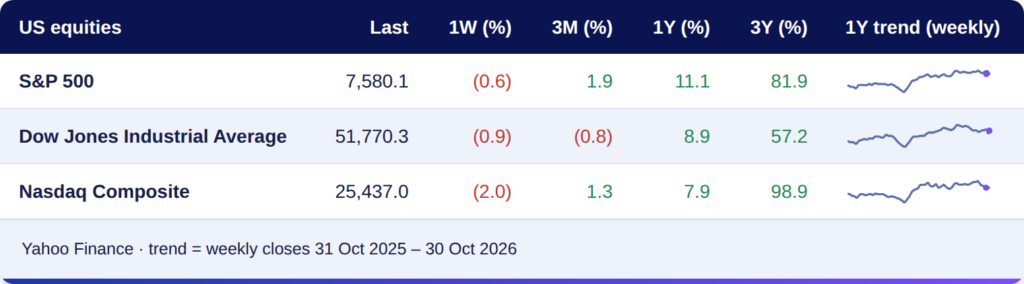
Indices: A volatile week ended lower. The S&P 500 fell 0.6% to 7,580.1, the Dow 0.9% to 51,770.3 and the Nasdaq 2.0% to 25,437.0, with Friday the worst day (S&P ‑1.8%, Nasdaq ‑2.9%). In October the Dow rose 1.5%, while the S&P 500 fell 1.2% and the Nasdaq 5.2% — its worst month since March 2025.
Drivers: Stocks rose early in the week on a rebound in chipmakers, then turned on big tech results. Alphabet fell more than 12% on Thursday after missing earnings estimates, even though cloud revenue roughly doubled to USD 30.7bn, and ServiceNow dropped about 25%. On Friday Intel fell 29%, its worst day since 1974, and Amazon slipped about 2% after an earnings miss and a negative trailing free cash flow of USD 42.4bn. Data were solid: Q3 GDP grew 3.4% annualised (3.2% expected) and core PCE inflation was 3.1% y/y, in line.
Breadth & earnings: The sell-off was concentrated in technology, while Oracle rose 10.7% on Wednesday on its FY2030 outlook. The VIX rose to about 19.4 on Friday. As at FactSet’s 23 October update, 24% of S&P 500 companies had reported Q3, 83% had beaten earnings estimates and blended earnings growth was 29.5%; a later update was not available.
Fed: The FOMC held the funds rate at 3.75–4.00% on 28 October in a 10–2 vote, with Cook and Hammack dissenting in favour of a 25bps hike. The statement said activity is expanding “at a strong pace” and inflation “remains elevated”, and Chair Warsh declined to give forward guidance. CME FedWatch put the chance of a hike at the 9 December meeting at about 80% on Thursday, and on Friday Fed presidents Logan, Musalem and Barkin argued for further tightening.
Fixed Income
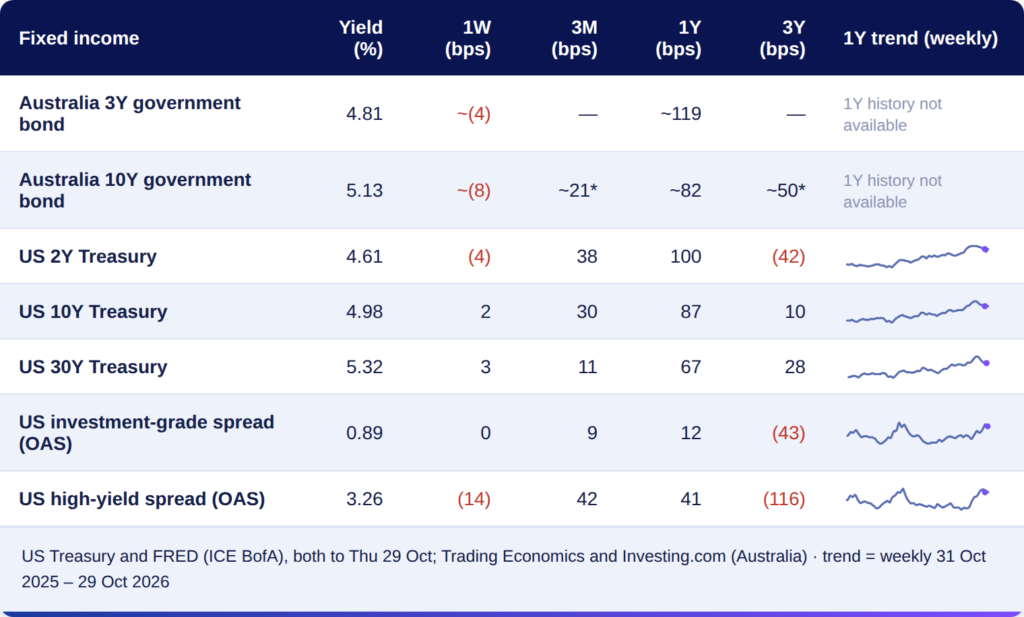
Australia: Australian yields fell despite the firmer inflation data, following the global safe-haven rally after weak big-tech results. The 10Y eased about 8bps to 5.13% and the 3Y about 4bps to 4.81%, so the front end held up better as markets moved to price an RBA hike on Tuesday. The 10Y is still about 82bps higher than a year ago, and sits roughly 20bps above the US 10Y.
US Treasuries: On Treasury’s official data, which run to Thursday 29 October, the 2Y fell to 4.61% from 4.69% a week earlier, the 10Y to 4.98% from 5.00% and the 30Y to 5.32% from 5.33%. The 10Y rose to 5.05% on FOMC day, slipped below 5% on Thursday and ended Friday near 4.93%, close to a seven-week low. The 2Y fell during Chair Warsh’s press conference, steepening the curve.
Credit: US investment-grade spreads were unchanged at 89bps, while high-yield spreads tightened 14bps to 326bps, reversing much of the previous week’s widening. Spreads remain tight by historical standards, so we continue to prefer quality over yield-chasing in high yield.
Our take: With US and Australian 10-year yields near 5%, high-quality bonds offer solid income and a buffer if the AI-led equity volatility deepens. We would keep adding duration gradually, as an RBA hike next week and a possible Fed hike in December leave short-term rates at risk of rising further.
FX & Commodities
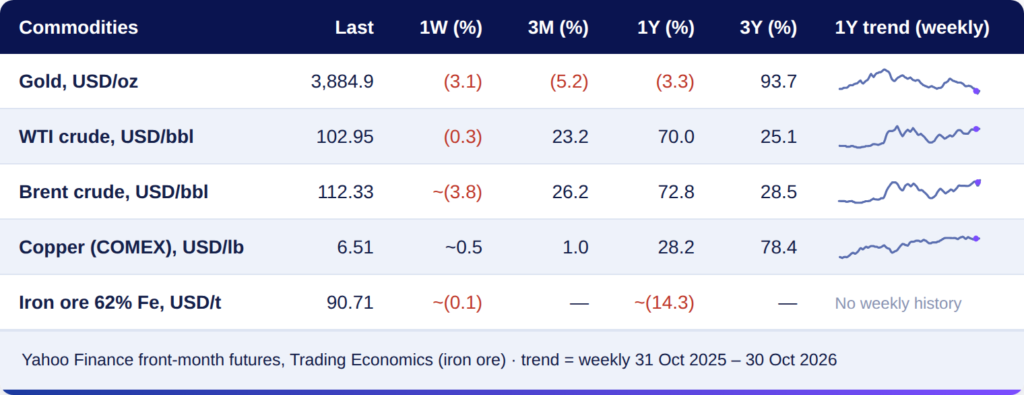
Energy: Oil stayed above USD 100 a barrel as Middle East risks persisted, with Houthi strikes claimed on Saudi facilities at Ras Tanura, Rabigh and Abqaiq and Iranian claims of mined tankers near the Strait of Hormuz (denied by US Central Command). WTI was flat on the week at USD 102.95. Front-month Brent fell to USD 112.33, but that mostly reflects the December contract’s expiry (it settled at USD 116.08, against USD 112.19 for January). Brent rose about 12% in October, a fourth straight monthly gain. Europe’s planned release of 42m barrels of reserves offset some of the supply worry, and US crude stocks fell 1.9m barrels.
Gold & metals: Gold fell 3.1% to USD 3,884.9 an ounce, its lowest since October 2025, after a 3.7% drop on Friday as higher-for-longer rate expectations and margin-call selling after the tech sell-off weighed. Silver fell 5.9% on Friday to about USD 49, below 50 for the first time since November 2025. Copper fell 2% on Friday but ended the week little changed near USD 6.51 a pound. Iron ore held near USD 91 a tonne after Singapore futures touched about USD 89 on Tuesday, the lowest since September 2024, on weak Chinese steel output and high port stocks.
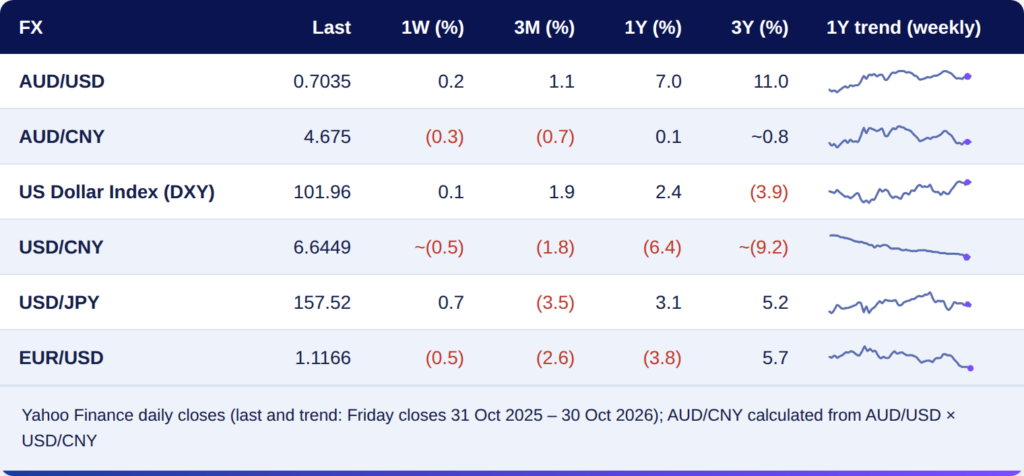
FX: AUD/USD edged up 0.2% to 0.7035, getting a brief lift after the CPI release as RBA hike odds rose. The US Dollar Index rose 0.1% to 101.96. USD/CNY fell 0.5% to 6.6449; the PBoC set its fixing at 6.7138, the strongest since February 2023 but weaker than expected, which suggests it wants to slow the yuan’s gains. AUD/CNY slipped 0.3% to 4.675. USD/JPY rose 0.7% to 157.52 after the BoJ held at 1.25% in an 8–1 vote, and EUR/USD fell 0.5% to 1.1166.
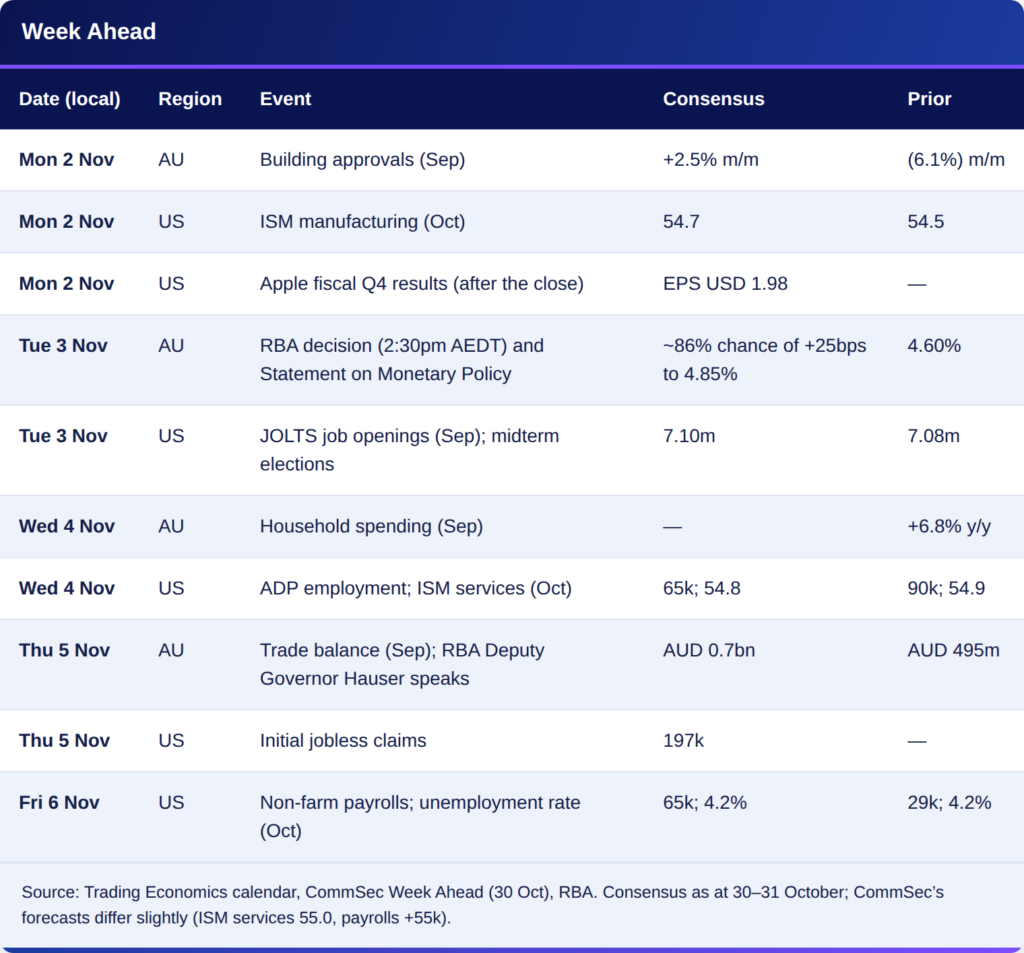
No Fed, BoJ or PBoC policy decisions fall in the week: the next FOMC decision is 9 December, the BoJ meets on 18 December and the PBoC’s next loan prime rate setting is 20 November. Fed speakers include Goolsbee (Mon), Hammack and Barkin (Thu), and Logan, Williams, Musalem and Bowman (Fri).
Questions about how this week’s moves could affect your portfolio? Speak with your BOA Private Wealth adviser.
This article is intended as general information only and does not constitute legal, financial or tax advice. Specific eligibility and the amount of any refundable tax offset should be determined based on the company’s individual circumstances and the applicable tax legislation.