


Midterm results whipsaw markets, the ASX 200 rises 1.3%, and oil drops about 13% on US–Iran talk hopes.
This week at a glance
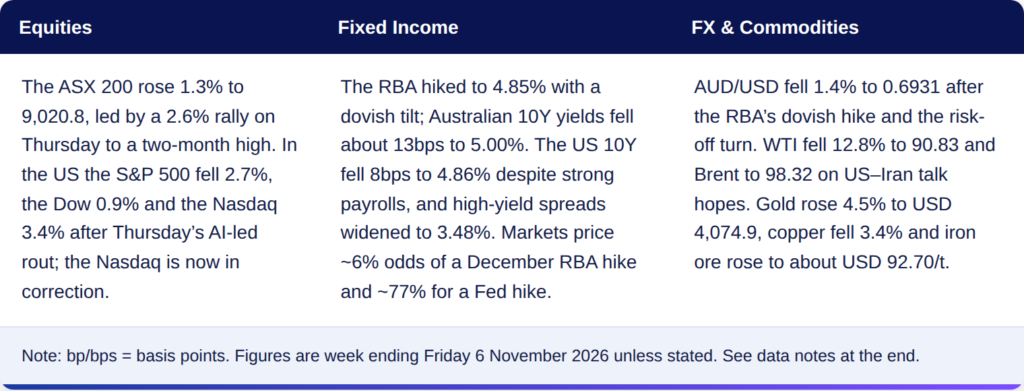
A Democratic sweep of the US midterm elections whipsawed markets, while the RBA delivered a widely expected but dovish-leaning hike. The RBA lifted the cash rate 25bps to 4.85% on Tuesday in a split 6–3 vote and dropped its tightening bias; swaps now price only about a 6% chance of another move in December. The ASX 200 still rose 1.3% to 9,020.8, helped by a 2.6% surge on Thursday. On Wall Street the Dow jumped 3.0% on Wednesday, before the S&P 500 fell 4.4% on Thursday, its worst day since April 2025, on fears a Democratic Congress will restrict AI data-centre building. For the week the S&P 500 lost 2.7% and the Nasdaq 3.4%. October payrolls rose 165,000, well above the 65,000 expected, keeping a December Fed hike about 77% priced. Oil fell about 13% on hopes of US–Iran talks, taking WTI to USD 90.83, while gold rose 4.5% to about USD 4,075. At BOA we see this as a repricing of AI policy risk rather than a turn in the economy. We continue to favour diversified portfolios, with quality bonds yielding 4.5–5% as ballast, and gradual, selective additions to quality growth on weakness.
Australia Market
ASX: The S&P/ASX 200 closed Friday at 9,020.8, up 1.3% for the week. It fell 0.6% on Monday ahead of the RBA, rose 0.3% on Tuesday as the hike came with a dovish tilt, and slipped 0.6% on Wednesday while the US midterm results came in. Thursday’s 2.6% jump to 9,065 was the index’s best day since April and a two-month high, after Wall Street’s post-election rally. Friday gave back 0.5% after the overnight US tech rout, with 154 stocks falling and 42 rising.
Sectors: Weekly sector figures were not available. Materials swung hardest: they led Thursday’s rally as copper and iron ore rebounded, then fell about 3% on Friday as copper hit its lowest since July (BHP ‑2.3%, Rio Tinto ‑2.0%). Energy lagged as oil slid. Defensives held up best, with utilities and staples up on Wednesday and Friday, and the big four banks rose on Friday (NAB +2.7%, Westpac +1.5%).
Corporate activity: NEXTDC surged 77% for the week after Ackland Investments, a Goodman–Digital Realty vehicle, bought up to 9.9% at AUD 9.50 a share, a 45.5% premium, days after NEXTDC cut FY27 revenue guidance to AUD 475–500m. NAB’s FY26 cash earnings fell 13.4% to AUD 6.14bn, below the ~AUD 6.33bn consensus, with an 85c final dividend. James Hardie’s FY27 EBITDA guidance of USD 1.446–1.534bn fell short of consensus. Department store David Jones entered administration, and the High Court ruled Uber must pay AUD 81m in NSW payroll tax.
RBA & macro: The RBA lifted the cash rate 25bps to 4.85% on Tuesday, its fifth hike of 2026 and the highest since 2008, but three of nine members voted to hold and the Board dropped its tightening bias. The Statement on Monetary Policy sees CPI at 4.5% in December and trimmed-mean inflation back at the top of the band only in late 2027. Governor Bullock said higher rates will make people “feel like it’s a recession”, and Deputy Governor Hauser warned that trust in the RBA is under strain. The trade surplus jumped to AUD 2.83bn in September and household spending rose 0.6%. Swaps price about a 6% chance of a hike at the next meeting on 8 December. The big four banks pass the hike on to variable mortgage rates from 13 November.

US Market
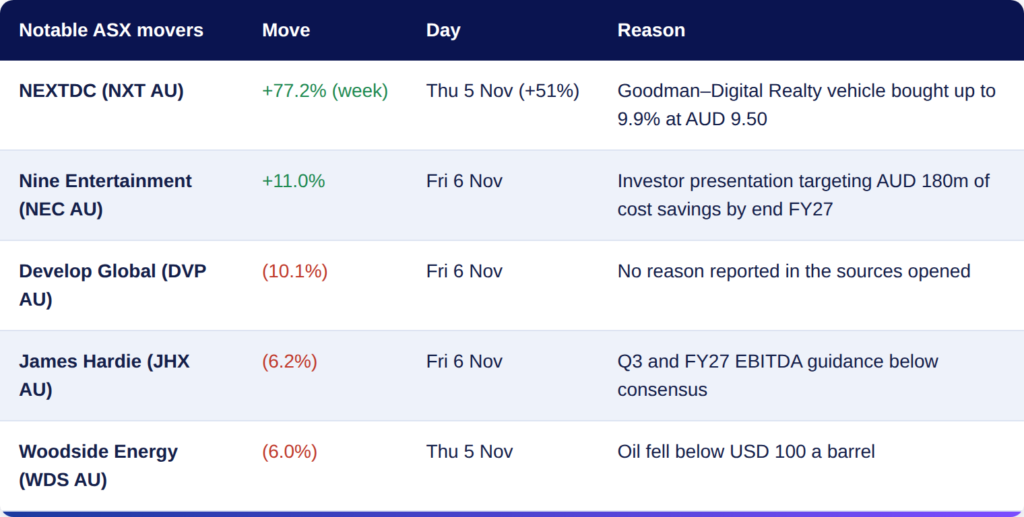
Indices: A violent week ended lower. The S&P 500 fell 2.7% to 7,376.9, the Dow 0.9% to 51,285.7 and the Nasdaq 3.4% to 24,579.4. The Dow surged 3.0% on Wednesday, its best post-midterm day in 44 years, before Thursday’s rout took the S&P 500 down 4.4% and the Nasdaq 5.5%, leaving the Nasdaq in correction. The VIX jumped about 70% to 28.2 on Thursday and eased to 25.6 on Friday.
Drivers: Democrats won both the House and the Senate on Tuesday. Stocks first rallied on lower oil and strong earnings, then sold off on fears a Democratic Congress will slow AI data-centre construction; voters backed limits in 40 of 41 local data-centre ballot measures. Data were strong: October payrolls rose 165,000 against 65,000 expected, unemployment fell to 4.1% and wages rose 0.4% m/m. ISM manufacturing rose to 55.5, and September job openings reached 7.52m.
Breadth & earnings: The sell-off was concentrated in semiconductors, with the SOX index down 12% on Thursday, its worst day since March 2020. AMD fell 15% and Micron 12% that day, Nvidia 9% and Intel about 10%, before AMD and Nvidia partly recovered on Friday. Apple slipped about 2% on Monday despite beating estimates, on slower growth and lower margins. Per FactSet, 88% of S&P 500 companies have reported Q3, 84% have beaten earnings estimates and blended earnings growth is 31.4%.
Fed: The funds rate is 3.75–4.00%. After the strong jobs report, CME FedWatch put the chance of a hike at the 9 December meeting at 76.8%, up from about 70% before the data. San Francisco Fed President Daly said further tightening is likely needed, preferably gradually, and called the tech repricing “painful but measured”.
Fixed Income
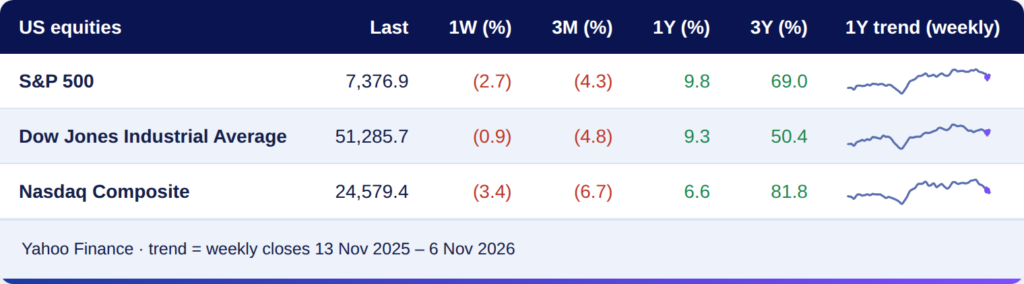
Australia: Australian yields fell as the RBA paired its hike with softer guidance and a split vote, and as the US Treasury rally after the midterms spilled over. The 3Y fell about 8bps on RBA day and ended the week near 4.70%, down about 11bps, while the 10Y eased about 13bps to 5.00%, near its lowest since late August. The 10Y is still about 65bps higher than a year ago and sits roughly 14bps above the US 10Y.
US Treasuries: On Treasury’s official data the 2Y fell 5bps to 4.51%, the 10Y 8bps to 4.86% and the 30Y 5bps to 5.26%. Yields dropped on Thursday’s flight to safety, with the 2Y touching 4.46%, then rose on Friday after the strong jobs report lifted Fed hike odds. The 2Y–10Y curve was little changed at about 35bps.
Credit: US investment-grade spreads were steady at 93bps, but high-yield spreads widened 16bps on Thursday alone to 348bps, about 34bps wider than on 28 October, as the tech sell-off hit risk assets. Spreads are no longer at their tightest, but still offer limited reward for lower-quality credit, so we continue to prefer quality.
Our take: With the RBA signalling a pause and US and Australian 10-year yields at 4.9–5.0%, high-quality bonds offer solid income and proved their worth as a buffer in Thursday’s sell-off. We would keep adding duration gradually, as a likely Fed hike in December still leaves short-term US rates at risk of rising.
FX & Commodities
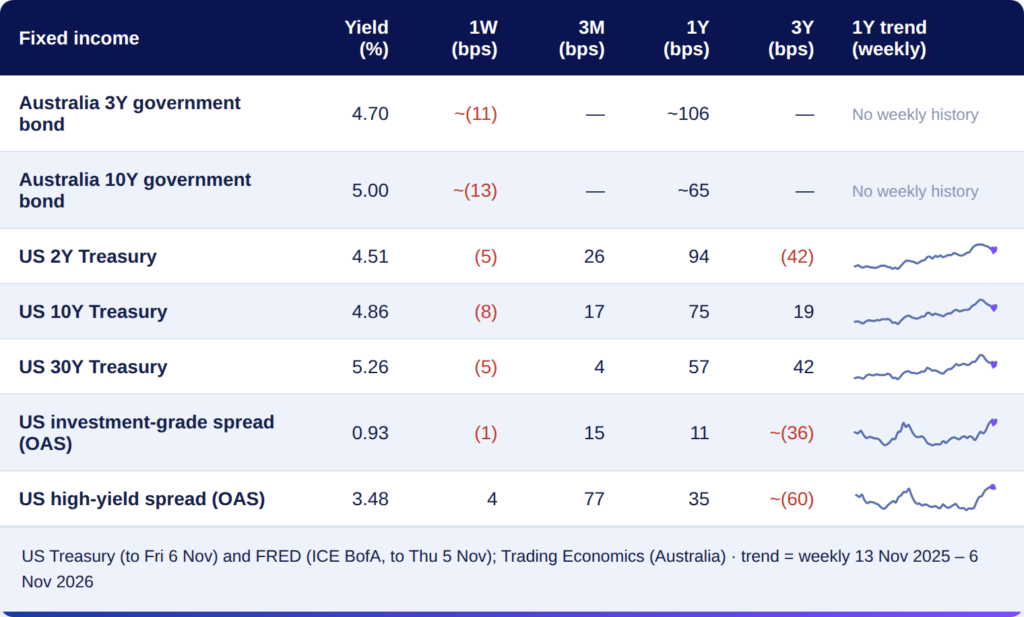
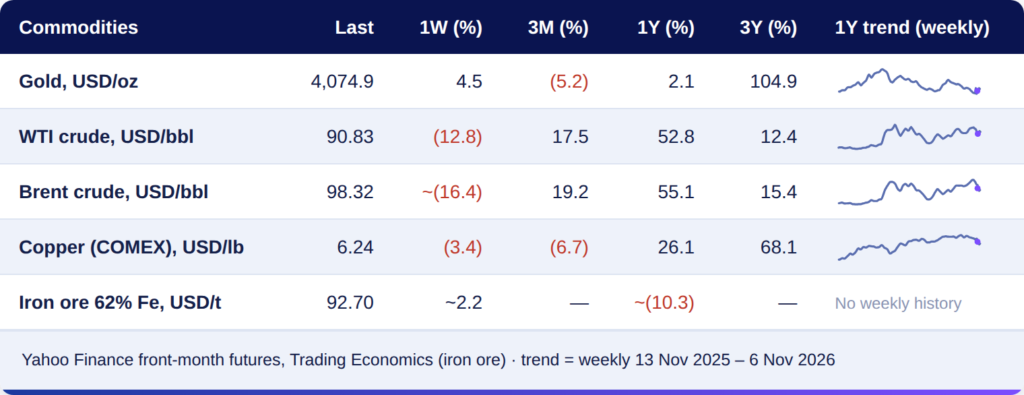
Energy: Oil had its steepest weekly fall in months as Iran sent a nuclear proposal to the US via Qatar, raising hopes of talks to reopen the Strait of Hormuz. WTI fell 12.8% to USD 90.83, including a drop of about 8% on Wednesday. Front-month Brent fell to USD 98.32; part of the 16% drop on Yahoo’s series reflects the roll to the January contract, and Trading Economics puts Brent’s weekly fall at about 13%. Big gaps remain: Iran wants the US blockade lifted and sanctions eased first, and tanker attacks near Hormuz remain near record levels.
Gold & metals: Gold rebounded 4.5% to USD 4,074.9 an ounce, helped by a 3.4% jump on Wednesday as investors sought safety from AI stocks, before easing on Friday as the US dollar firmed after payrolls. Silver rose about 4–6% to about USD 51.9. Copper fell 3.4% to USD 6.24 a pound, its lowest since July, on fears that US limits on data centres will cut demand. Iron ore rose about 2% to USD 92.70 a tonne, after touching a four-week high on Monday.
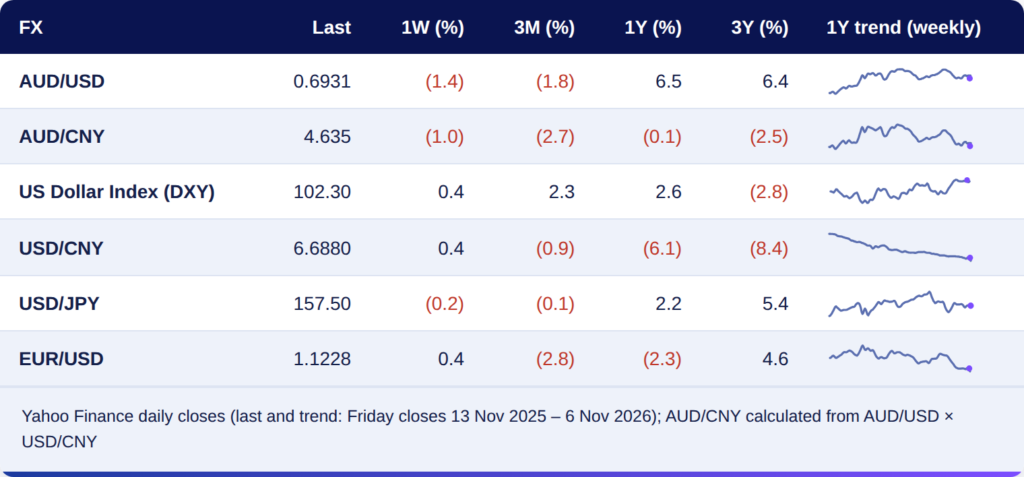
FX: AUD/USD fell 1.4% to 0.6931 as the RBA dropped its tightening bias and global risk appetite faded, and traded near 0.686 late on Friday. The US Dollar Index rose 0.4% to 102.30, with a 0.7% gain on Friday after the jobs data. USD/CNY rose 0.4% to 6.6880, after the PBoC raised banks’ FX reserve requirement from 4% to 6% from 15 November, a move that drains about USD 24bn and signals it wants to slow the yuan’s rise; the yuan had its biggest daily fall in six months on Monday. AUD/CNY fell 1.0% to 4.635. USD/JPY eased 0.2% to 157.50 as the yen drew safe-haven demand, and EUR/USD rose 0.4% to 1.1228.
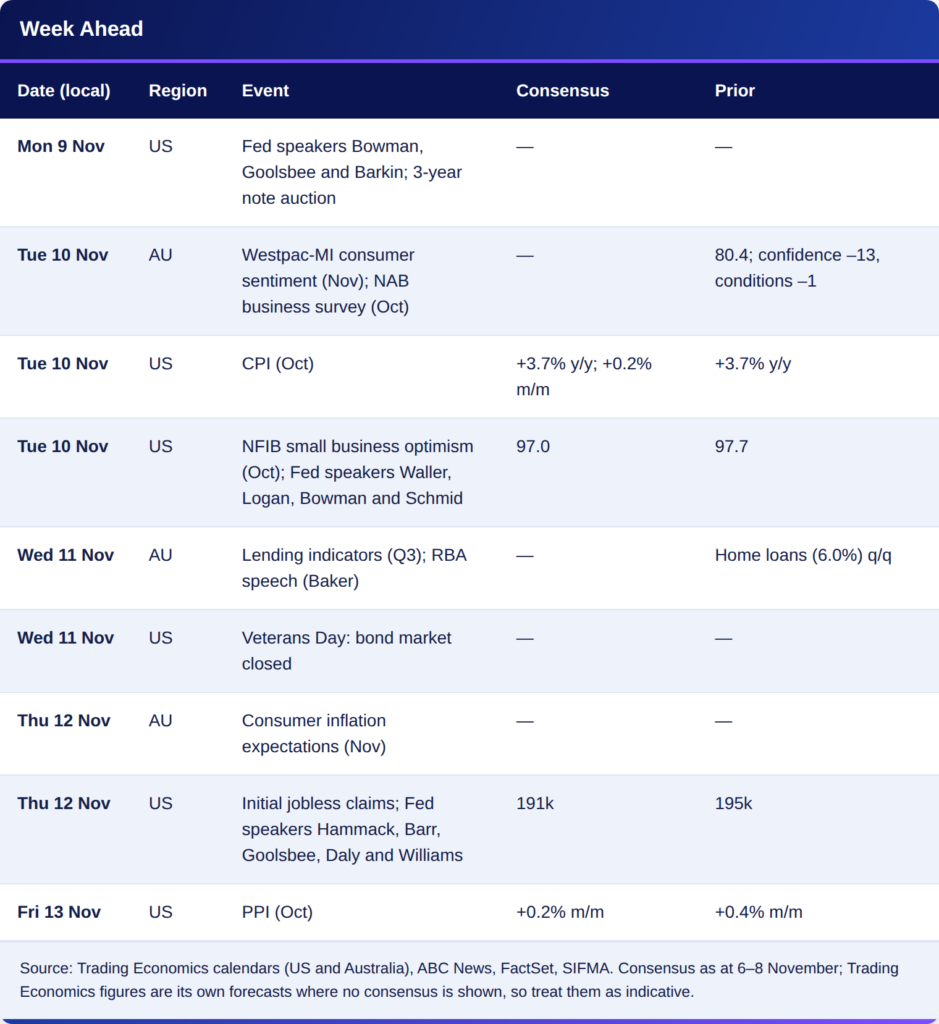
No RBA, Fed, BoJ or PBoC policy decisions fall in the week: RBA minutes are due on 17 November and the next RBA decision is 8 December, the FOMC decides on 9 December, the BoJ meets on 18 December and the PBoC’s next loan prime rate setting is 20 November. US retail sales follow on 17 November, and only 13 S&P 500 companies report earnings this week.
Questions about how this week’s moves could affect your portfolio? Speak with your BOA Private Wealth adviser.
This article is intended as general information only and does not constitute legal, financial or tax advice. Specific eligibility and the amount of any refundable tax offset should be determined based on the company’s individual circumstances and the applicable tax legislation.